12 Day Classic Namibia Camping Safari
Exciting Namibia Safari and Tour
Namibia is a land of contrasts, and this scheduled 12-day camping safari is perfectly designed to take in nearly all of them. Starting in Windhoek, this tour includes visits to Mount Etjo Game Reserve, Etosha National Park, Otjikandero Himba Village, Skeleton Coast National Park, Swakopmund, and Sossusvlei, and then back to Windhoek.
Key information
- Group safari
- Maximum 10 participants in a safari vehicle
- Children from the age of 5 years are allowed to participate under the supervision of a parent or guardian
- Starting point and ending point: Windhoek
- English-speaking guide
- Park fees included
Highlights
- Explore the towering red dunes of Sossusvlei and the surreal beauty of Dead Vlei
- Witness abundant wildlife in Etosha National Park’s vast salt pan and waterholes
- Discover the haunting Skeleton Coast with shipwrecks, fog, and desert-adapted wildlife
- Visit the dramatic Fish River Canyon, one of the largest canyons on Earth
- Experience the living culture of the Himba people in northern Namibia
- Transportation in a 10-seater custom-built Safari vehicle with AC and USB charging port
- Visit 100,000 seals at Cape Cross
- 10 nights in tent and 1 night in a hotel
Types
11 activity days in English
Accommodation
You will stay in tents for 10 nights and 1 night in a hotel. Single travelers will be matched with another traveler of the same sex on a twin-share basis.
Program
Starting in Windhoek and heading out on the northern leg of this odyssey, the winding road takes you to visit Mt Etjo and Okonjati Nature Reserve and the big game in the iconic Etosha National Park. The activities include the privilege of nighttime viewing at the world-famous Okaukuejo waterhole. You meet and engage with the Himba Tribes people and travel over mountain passes with exotic and beautiful views.
On the southern leg, you spend time in the rugged and forbidding Skeleton Coast National Park, visit 100,000 seals at Cape Cross, and take in a shipwreck on your way to the slightly bizarre holiday town of Swakopmund. Here, you can shake out a little of the dust and enjoy a hotel bed, great restaurants, and many exciting excursions.
You cross the Tropic of Capricorn on your way to visit the world’s highest sand dunes in the world’s oldest desert at Sesriem & Sossusvlei. You see the crumbling yet beautiful and historic architecture in Lüderitz, and you learn about the desert diamonds and visit the eerie diamond ghost town at Kolmanskop. The awe-inspiring Fish River Canyon, the second-largest canyon on planet Earth, awaits you, and finally, you visit the unusual and ancient quiver trees.
Itinerary
Day 1, Saturday: Windhoek - Mt. Etjo and Okonjati Nature Reserve – 230 km
You will be collected from their accommodation within the Windhoek city limits at 07:15 and transferred to Chameleon Headquarters for a short pre-departure meeting.
Heading north, you will make your first stop in the small town of Okahandja, where they will find Namibia’s largest wood carving market. Craftsmen from all over Namibia come here to showcase a wide variety of items, both large and small. Here, guests have the opportunity to collect a truly Namibian souvenir and at the same time support the local artists and communities.
Onwards to the overnight destination at Mt. Etjo campsite, which is located adjacent to the private Okonjati Game Reserve. After making camp and preparing lunch, the group will drive the three kilometers to the lodge, where there will be time to explore the grounds and have a dip in the pool.
The lodge is built in an attractive Moroccan style, with red terracotta buildings and abundant palm trees and lawns. Around the lodge and throughout the Okonjati Reserve, rainwater dams have been built, creating, after good rains, many large pools and small lakes.
Around the main lodge area, the lake is extensive and supports a small population of hippopotami. The habitat that these huge ‘water cows’ enjoy at the lodge is artificial, as hippos do not occur naturally in this semidesert region of Namibia. It does, however, offer guests the privilege of perhaps seeing and photographing this iconic African species without having to travel many kilometers to the far north of Namibia.
Time for the first game drive: the group will meet their local guide and climb aboard open game-viewing vehicles for an approximately three-hour excursion into the reserve. The reserve is 36,000 hectares (nearly 90,000 acres) and is as abundant in magnificent scenery as it is in wildlife. The overall terrain is dotted with truly huge copper-red and grey termite mounds and is rich in native vegetation, dominated by Vachellia (formerly Acacia), thorn scrub, and standing mopani trees.
Okonjati Reserve is largely free of invasive vegetation, thanks in part to the healthy appetites of the resident pachyderms and other shrub-browsing species found here. This allows for areas of open and semi-open grassland savanna, crisscrossed with many dry streams and riverbeds—perfect for the game and ideal for guests, as the open landscape makes game viewing and photography a pleasure.
You can hope to encounter big game, particularly elephant and rhino, while also watching out for giraffe and other smaller species. Springbok, wildebeest, impala, and kudu are numerous, and mammals like warthogs, steenbok, and Damara dik-diks may also be spotted by keen eyes. In the bush and around the seasonal waterholes, both game and birdlife are abundant.
Not to be outdone by the wildlife, the scenery remains dominant: pristine bush under the truly iconic African big skies, with a backdrop of towering red and grey sandstone massifs. It doesn’t get much better than this. Around sunset, the group will stop for some refreshments before returning to the lodge and then heading back to the campsite, where dinner will be cooked by the guide over an open fire.
The day is not over yet.
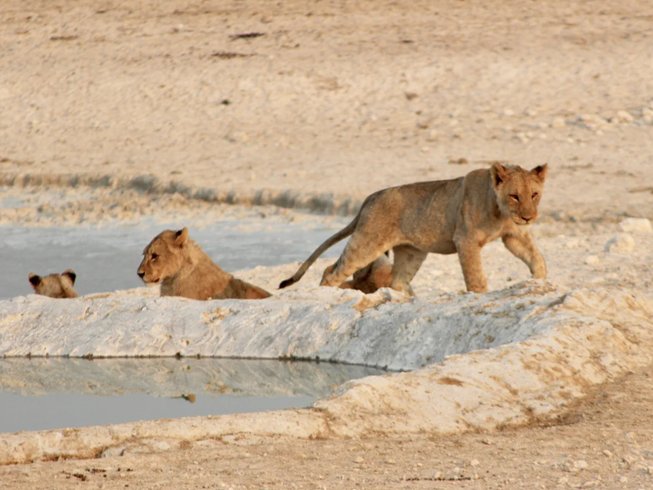
After dinner, you head back to the lodge to watch some of the resident lions enjoy their evening meal. These big cats are permanent residents at Mt. Etjo and have their own large secure enclosure where they live and can hunt naturally. From a secure hide offering a close-up view, you can watch and photograph these magnificent animals as they arrive to enjoy the extra snack laid out for them.
From here, you return once again to camp, where, after a full day, they can finally settle down for their first night under canvas.
Accommodation: Twin-share tents, shared ablution at campsite
Meals: Lunch & dinner
Day 2, Sunday: Mt. Etjo - Okaukuejo - Etosha National Park – 280 km
Departing after breakfast, you head back to the main road to continue their journey north, en route to Etosha National Park. A short stop is made for essential supplies in the small town of Otjiwarongo before continuing on to Etosha’s main camp at Okaukuejo.
The park is introduced with a short game drive between the main entrance gate (Anderson Gate) and Okaukuejo Camp, offering a good chance to spot big game right from the very start. Etosha is vast—just over 22,000 square km—and is home to 114 species of mammal, 350 species of bird, 110 species of reptile, uncountable numbers of insects, and, somewhat unusually, one species of fish.
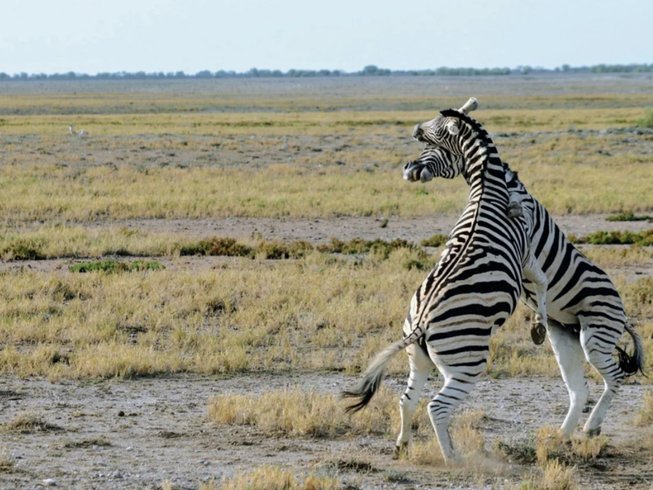
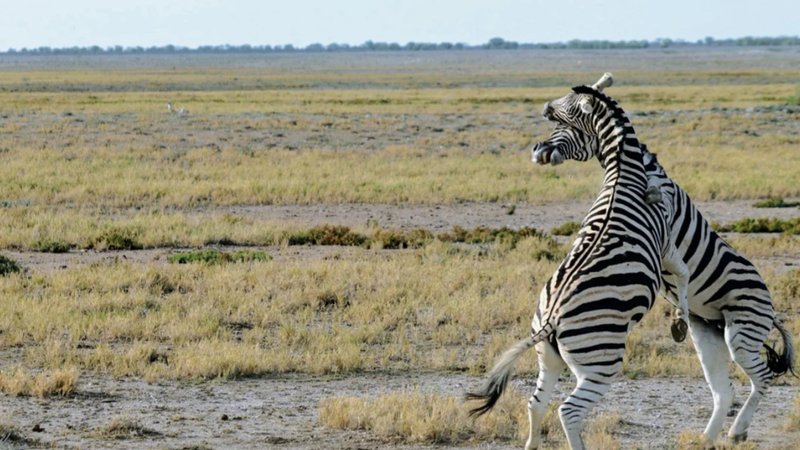
After setting up camp, the group heads out into Etosha in search of big game. Elephants, rhinos, giraffes, and big cats are often seen in this area. Smaller species are also abundant, with several types of antelope and gazelle, common sightings of zebra, and spectacular birdlife.
All visitors must return to camp at sunset, but the ‘game show’ does not stop when the sun goes down. Accessible on foot and only a short walk from the campsite, Okaukuejo is renowned for its floodlit waterhole, where guests have the opportunity to see many of Etosha’s highlights. Big cats, elephants, and a wide range of smaller game can be observed, but in particular, this is one of the best chances to see a black rhino up close. Namibia is the last stronghold of these critically endangered animals, and here at Okaukuejo, they are regular visitors.
Accommodation: Twin-share tents, shared ablution at campsite
Meals: Breakfast, lunch & dinner
Day 3, Monday: Okaukuejo - Halali - Okaukuejo - Etosha National Park
You aim to be on you way as the sun breaches the horizon. You head to the gate where they meet their local guide for the day. Together with a guide, you explore Etosha on an open game viewer. Early morning is usually a productive time for game viewing, and it is a good time to catch big cats returning from the hunt.
Etosha is a desert landscape, and water is the most scarce natural resource. There are, however, numerous waterholes here, both natural and man-made, and the group’s game driving technique is to visit as many of these as possible. Here, they hope that the game will come to them as animals gather for an early morning drink. Along the way, a stop is made at a designated picnic area for a quick breakfast before continuing the game drive en route to the camp at Halali.
The name "Halali" is taken from a bugle call originally used during sport hunting with horses and hounds in Europe, signaling that the hunt was over. This was considered appropriate for Etosha, as within the protection of the park, the hunting of animals has ended.
Lunch is enjoyed at Halali. There is a small shop with basic merchandise and a few souvenirs, and there is also time for a swim in the pool. Guests may also visit the Halali camp waterhole before heading back out into the park for the afternoon game drive. On the way back to Okaukuejo, the group stops to take a closer look at the Etosha Pan. The name 'Etosha' translates as ‘great white space,’ but this does not fully capture the immensity of the pan—over 4,700 square km of dazzling white mineral surface, so vast that it can be seen from space.
Keeping a sharp lookout for game as they make their way back to Okaukuejo, the group aims to arrive just before sunset, in time for the best hour of the day at the Okaukuejo waterhole.
Accommodation: Twin-share tents, shared ablution at campsite
Meals: Breakfast, lunch & dinner
Day 4, Tuesday: Okaukuejo - Palmwag – 320 km
Time for you to leave Etosha and concentrate on some of Namibia’s other highlights. You will have an early breakfast and enjoy a game drive on your way out of the park and back to the main road.
Your first stop of the day is a fascinating cultural visit to the Otjikandero Himba Village, located close to the small town of Kamanjab. The Himba people traditionally have their homeland in the very far north of Namibia in extremely remote yet beautiful areas.
Because their communities were so isolated, the influence of the modern world took a little longer to reach them, and they continued living their traditional lifestyle much longer than other ancient cultures. With the advent of tourism and the natural flow of change, many Himba have migrated further south, but traditions die hard, and among the ethnic groups in Southern Africa, many Himba tribespeople still retain and live their traditions to this day.
The Otjikandero Himba Village is a living village, meaning that people live there on a permanent basis and largely adhere to their traditional cultures. It is not a time capsule—the 21st century has arrived here as well—but it remains a good representation of traditional Himba life. They will be invited into the village, their visit will be guided, and they will be encouraged to take photos and ask questions, ensuring there are no feelings of invading anyone’s privacy.
After their visit to Otjikandero, they will have a short stop in Kamanjab before continuing their journey. The next leg of the journey is truly spectacular as they turn west and head towards the Etendeka Mountains and the Grootberg Pass. Etendeka translates as ‘flat top,’ and indeed many of the surrounding mountains have flat table-tops. The terrain here is covered with small uniform boulders, a legacy of the break-up of Gondwanaland when what is now Southern Africa separated from what is now South America around 180 million years ago. This period of massive volcanic upheaval left behind the same rocks (Etendeka basalts), which can also be found in abundance in Brazil. As they travel through this rocky landscape, they can enjoy sweeping views and spectacular scenery of this ancient land.
Palmwag is set along the Uniab River and under swaying makalani palm trees, which often provide a refuge for Namibia’s unique desert-adapted elephants. These elephants sometimes come very close to their camp and occasionally even visit, with some known to drink water from the swimming pools. They will arrive in the late afternoon and set up camp in time to enjoy a sundowner and hopefully see some of the resident elephant herds.
Accommodation: Twin share tents, shared ablution at campsite.
Meals: Breakfast, lunch & dinner
Day 5, Wednesday: Palmwag - Spitzkoppe – 420 km
You have reached the limit of your northern adventure, and today you first head west to the Atlantic Ocean and then directly south, following the coastline to Cape Cross.
Set off through more beautiful scenery, passing many weird and wonderful species of vegetation that this area is famous for. In particular, you will see Namibia’s national plant, the remarkable and endemic Welwitschia mirabilis. This species is, in fact, a dwarf tree and is found only in Namibia and southern Angola. The Welwitschia is a drought-resistant marvel and almost as old as the landscape itself, with some specimens known to be over 1,500 years old.
Enter the Skeleton Coast National Park through the northern Springbokwasser Gate, and soon afterwards you encounter the chilly Atlantic Ocean. It is easy to see why this barren seaboard is called the Skeleton Coast, with its forbidding mountains and desolate beaches. The wind, waves, and heavy fog banks often push ships onto the shore. In the past, countless mariners who were shipwrecked here faced the harsh reality of no fresh water, no food, no rescue, and a slow death by exposure—while those who went down with their ships were considered the fortunate ones.
There are also remnants of human activity along their route today. In the early 1960s, two pioneering entrepreneurs, Jack Scott and Ben du Preez, believed that both oil and diamonds could be found along the Skeleton Coast, seeing it as their chance for fame and fortune. At great expense, they installed a massive drilling rig and reached a depth of 1,700 meters before admitting there was no oil.
Undeterred and encouraged by reports of large diamonds at Cape Cross, they built a diamond mine and processing plant at Toscanini, near their abandoned drilling site. Some diamonds were reportedly “found,” but there were strong suspicions that the plant had been seeded with stones from elsewhere to reassure investors. Both ventures ultimately failed, but they will pass by Toscanini and may stop to view the now-collapsed drilling rig.
After exiting the park at the Ugab River crossing, with its iconic gates, they continue on to one of the largest seal colonies in the world.
No one knows exactly why the seals chose Cape Cross as their home, but there must be a compelling reason, as there are often more than 100,000 seals basking on the rocks or swimming offshore. These Cape fur seals are found only in South Africa, Namibia, and Angola, and are nearly endemic to Namibia. Cape Cross hosts the largest colony in the world, though many smaller colonies exist along Namibia’s coastline. The site is both astonishing and notoriously pungent—arguably the smelliest stop on your safari.
Cape Cross takes its name from the stone crosses located near the seal colony. The first was erected in 1485 on the orders of Portuguese mariner Diogo Cão. At the time, such a cross was called a “padrão,” and the area was named Cabo do Padrão, or Cape Cross. The original cross is now housed in a museum in Germany, while the two visible today are replicas erected by the German government and the monuments council of South Africa. The concrete discs surrounding them are arranged to represent the stars of the Southern Cross, honoring the navigational skills of early explorers. Diogo Cão never returned to Portugal from this voyage, and the circumstances of his death remain a mystery.
You then continue inland to the striking Spitzkoppe Mountain. These granite peaks rise dramatically from the surrounding plains and are renowned for spectacular sunrise and sunset views, as well as excellent night photography opportunities. After setting up camp, you will head into the mountains to enjoy the sunset before returning for dinner.
Accommodation: Twin share tents, shared ablution at the campsite.
Meals: Breakfast, lunch & dinner
Day 6, Thursday: Spitzkoppe - Swakopmund - Hotel A La Mer Swakopmund
After breakfast and breaking camp, you head back to the coast and then continue south along the shoreline to Namibia’s adventure capital, Swakopmund.
Heading south on the coastal road, your first stop is a more recent shipwreck. About 15 km south of the small town of Henties Bay, the fishing trawler Zeila, ran aground in 2008. The vessel, already destined for scrap, was under tow when the cable snapped. Like many ships before it, it was caught in the strong currents and swell and ended up stranded on the beach. The wreck lies close to shore and offers an excellent photo opportunity.
Continuing along the coast, you make another fascinating stop before reaching Swakopmund. Namibia is home to a world-record number of lichen species, and along this stretch of coastline lie vast lichen fields—rare in both scale and nature globally. Lichen may resemble plants and share some similar functions, but they are actually composite organisms. The types found here are known as macro-lichen, typically bush-like or leafy in appearance.
What makes lichen particularly remarkable is that they consist of two organisms: algae and fungi. Neither can survive independently in this harsh environment, but together they form a symbiotic relationship that allows both to thrive. The fungi collect moisture, while the algae produce food through photosynthesis. Although lichen have no roots, the algae component enables them to generate the nutrients both organisms need.
Rain is rare along the Skeleton Coast, but the region is famous for its fog, which can occur up to 250 days a year. The organisms here, including lichen, are specially adapted to rely on fog as their primary water source. However, lichen are extremely fragile, growing at a rate of only about one millimetre per year and easily damaged. Off-road driving and even foot traffic can cause lasting harm. Their guide will indicate where they are permitted to walk, and great care must be taken to avoid damaging these delicate ecosystems.
You then complete the final leg of your journey into Swakopmund. For the night, you leave their tents behind and check into your accommodation, the centrally located Hotel A La Mer Swakopmund, originally founded by Captain Kurt von François of the German imperial colonial army in 1892 (he also founded Windhoek in 1890).
Swakopmund is a unique town, bordered on three sides by the vast sand dunes of the Namib Desert and on the fourth by the Atlantic Ocean. The town still features many examples of German colonial architecture, and the German language remains widely spoken.
There are plenty of ways for them to spend their time in Swakopmund. The town centre is compact and easy to explore on foot, while a wide range of optional activities is available. Scenic flights over the desert are popular, and those seeking adventure might try skydiving or quad biking on the dunes. Their guide will discuss all options in advance and assist with bookings. For a more relaxed experience, they can opt for bicycle tours or the popular “Living Desert” excursions, where a specialist guide introduces them to the remarkable plants and animals that survive in this extreme environment.
Lunch and dinner will be at your own expense, and Swakopmund offers a variety of excellent restaurants. Their guide will be happy to provide recommendations and assist with reservations.
Accommodation: Twin share rooms, en-suite bathroom
Meals: Breakfast
Day 7, Friday: Swakopmund - Sesriem – 350 km
Making the most of your time at the coast, you only leave Swakopmund at 11:30 this morning, giving you plenty of time to explore the town. Alternatively, there are several optional activities available if you wish to make the most of the morning.
If you’re seeking an adrenaline rush, sandboarding is a popular option, offering you the chance to speed down the face of a sand dune at up to 60 km per hour. This activity is typically available only in the morning.
Departing Swakopmund no later than 11:30, you head east into the desert. You first cross the Namib gravel plains—vast stretches of flat, seemingly barren terrain punctuated by large mountain inselbergs. During the afternoon, you traverse two mountain passes. The first is the impressive Kuiseb Pass, where you follow the road from the mountain tops, descending steeply into the canyon carved over millennia by the Kuiseb River as it makes its way to the Atlantic Ocean near Walvis Bay.
You then climb up from the riverbanks and continue through the mountain peaks toward the second, smaller canyon formed by the Gaub River, a tributary of the Kuiseb. Emerging from the mountains onto flatter terrain, you soon reach the Tropic of Capricorn at 23.5 degrees south. A signpost marks this notable location, and you stop for photos.
From here, you continue through the desert landscape to the small settlement of Solitaire, where you can stretch your legs and sample the famous apple pie that has made this homestead well known. You then proceed to your destination for the day—Sesriem, the gateway to the dunes and Sossusvlei.
You set up camp in the shadow of the towering red dunes of the world’s oldest desert, in anticipation of the next day’s adventure.
Accommodation: Twin share tents, shared ablution at the campsite.
Meals: Breakfast, lunch & dinner
Day 8, Saturday: Sesriem - Sossusvlei - Sesriem – 120 km
Sunrise in the dunes is the focus this morning, which means an early pre-dawn start. Your first stop is Dune 45, so named because it lies 45 km from Sesriem, and you cover this distance in darkness and early morning twilight.
The best time to photograph the dunes is around sunrise and sunset, when the towering sands glow in shades of orange and apricot red on one side while the other remains in deep shadow. At this time of day, the depth and contrast of the landscape are especially striking.
You arrive at Dune 45 and climb to a vantage point for sunrise, watching as the colours shift and intensify with the changing light. Afterward, you return to the vehicle for a quick breakfast before continuing the final stretch to the 2x4 car park, where you transfer to 4x4 shuttle vehicles for the journey into the vlei. From there, you enter the ancient Tsauchab Riverbed for the last 5 km to Sossusvlei itself.
The Tsauchab River is ephemeral, flowing only when sufficient rainfall occurs. For most of the year, the riverbed remains dry. In the distant past, during periods of significant flooding, the river occasionally reached the Atlantic Ocean. However, over millions of years, shifting sands gradually blocked its course. As dunes formed and expanded, windblown sand filled the river channels until the floods could no longer break through. Today, Sossusvlei marks the permanent endpoint of the river.
Although rare, Sossusvlei can still flood—perhaps once a decade—following heavy rains in the Naukluft Mountains where the river originates. When this happens, a temporary lake forms and can remain for several months, though the river no longer reaches the ocean.
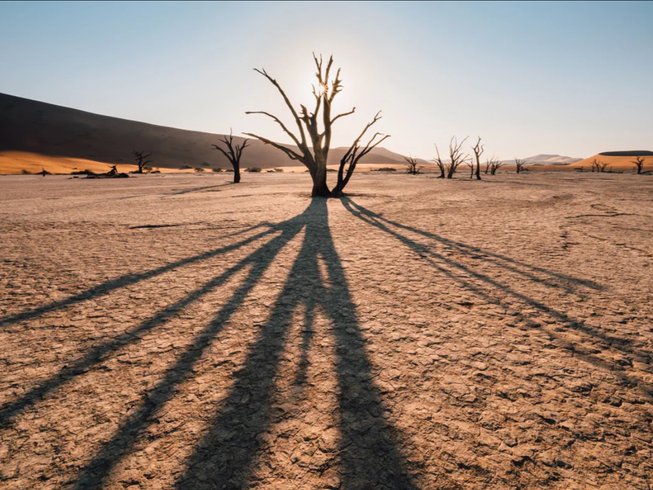
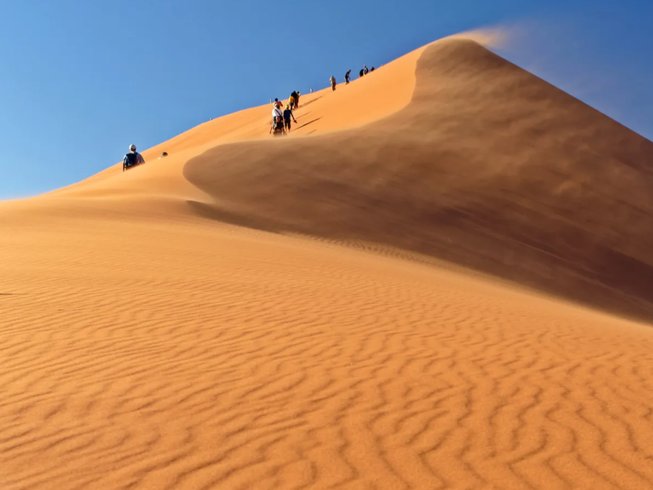
The 4x4 shuttle transports you through the sandy terrain, after which you explore Dead Vlei on foot with your guide. This ancient clay pan, surrounded by towering dunes, is dotted with the stark remains of camel thorn trees that have stood for over 1,000 years. Sossusvlei itself is nearly enclosed by dunes, with only a narrow passage kept open by the Tsauchab River. You have time to explore the area on foot and even climb one of the world’s highest dunes, rising up to 300 meters, offering breathtaking and iconic views.
You return to Sesriem for lunch and may enjoy a refreshing swim before heading out again in the afternoon for a short excursion to Sesriem Canyon.
Located just four kilometers from your campsite, this canyon was carved by the Tsauchab River. Around two million years ago, an ice age in Europe caused glaciers to form, lowering global sea levels. This, in turn, increased the flow and erosive power of the Tsauchab River, enabling it to cut deeply into the landscape and create the canyon visible today. You can walk into the riverbed, where temperatures are often cooler, and follow part of the river’s course toward Sossusvlei.
In the late afternoon, there is one final optional activity to conclude your time in the world’s oldest desert. A short drive takes you to Elim Dune, known for its exceptional golden light at sunset. From there, you may choose to take a short walk back through the desert to your camp.
Accommodation: Twin share tents, shared ablution at campsite
Meals: Breakfast, Lunch, Dinner
Day 9, Sunday: Sesriem - Klein Aus Vista – 350 km
You have a scenic drive today through ever-changing desert landscapes, mountains, and open grasslands. You continue your journey south, with your destination being the small community of Aus, located in the Aus Mountains above the plains of the Namib Desert.
Aus was formerly the site of a prisoner-of-war camp established by the South African army to house German prisoners during the Second World War.
Your final destination for today is Klein Aus Vista, situated just outside Aus and within the private Gondwana Sperrgebiet Rand Park. You aim to arrive in the early afternoon and set up camp, allowing time to stretch your legs on the unguided hiking trails around the property.
The landscape offers wide open vistas, and you can look forward to a potentially spectacular sunset.
Accommodation: Twin share tents, shared ablution at campsite
Meals: Breakfast, lunch, dinner
Day 10, Monday: Klein Aus Vista - Lüderitz - Klein Aus Vista – 250 km
You start early again, but with the comfort of a properly sealed tar road today. You travel through grasslands and wide-open desert scenery on an easy drive toward the ocean.
Desert-adapted horses roam freely in this area, so you need to keep a good lookout for these remarkable animals. Horses are not naturally part of the desert ecosystem, and their origins here remain uncertain. They may be descendants of German cavalry horses from the First World War, or possibly linked to Hans Heinrich von Wolf, owner of Duwisib Castle in 1909, who was known for breeding horses. Some believe the present-day population originated from his stock escaping into the wild. Whatever their true history, seeing them in this harsh environment is a unique experience.
You continue toward the ghost town of Kolmanskop, located about 15 km from the port town of Lüderitz. For centuries, sailors told stories of hidden riches along distant coasts—stories that were often dismissed as myths. However, in southwestern Namibia, those tales proved true.
When diamonds were first discovered here, they were so abundant that people could reportedly collect them straight from the beach. Kolmanskop, established in 1908, became the first diamond mining town and was built in the style of a German village, complete with modern amenities for its time. It featured a hospital with the first X-ray machine in the Southern Hemisphere, as well as a power station, school, ballroom, and ice factory.
The town began to decline around 1920 as diamond supplies dwindled. In 1928, even richer deposits were discovered 270 km further south near the Orange River, leading to Kolmanskop’s abandonment. Over time, the desert reclaimed the town, filling buildings with sand. Today, it remains a striking and photogenic site. You stop here for a guided tour and the opportunity to explore and photograph this fascinating ghost town.
After leaving Kolmanskop, you continue the short distance to Lüderitz, a coastal town known for its colorful colonial-style buildings. You drive along the Lüderitz Peninsula, taking in the scenery on your way to Diaz Point. Like Cape Cross, this area marks early European exploration by the Portuguese.
In 1487, Bartolomeu Dias landed here and erected a stone cross, naming the area Angra das Voltas, or “Bay of Tacks,” referring to the repeated maneuvering of his ship against strong winds. Lüderitz remains one of the windiest places on Earth, a reminder that some conditions have changed little over the centuries.
You then return to Klein Aus Vista, with another chance to spot the desert horses along the way, arriving in time to enjoy a relaxing sundowner.
Accommodation: Twin share tents, shared ablution at campsite
Meals: Breakfast, lunch & dinner
Day 11, Tuesday: Klein Aus Vista - Quiver Tree – 550 km
You have a long drive today, but you take advantage of the tar road for the first part of the morning. You head east before turning south again to complete your journey through Namibia’s southern region. Your first main stop is the remarkable Fish River Canyon, located in the /Ai-/Ais Richtersveld Transfrontier National Park. You enter the park at the Hobas Gate, and from there it is only a short drive to the main viewpoint overlooking the canyon.
Second in size only to the Grand Canyon, the sweeping vistas across this immense natural formation are breathtaking. From your vantage point high on the plateau, you overlook the famous “Hell’s Bend,” a dramatic curve carved by the Fish River. The canyon stretches 160 km in length, up to 27 km in width, and reaches depths of around 550 meters. Its origins date back roughly 1.8 billion years, shaped by a powerful combination of geological forces—seismic activity, volcanic eruptions, earthquakes, glaciation, and continuous erosion—further deepened over time by the Fish River flowing far below. It is a striking example of nature’s raw power and scale.
Although it is difficult to leave such an impressive sight, you continue your journey, turning north again as the canyon marks the end of the southern leg of your trip. You head toward Keetmanshoop, the main commercial and administrative center of southern Namibia. After a short stop, you continue to your overnight destination at the Quiver Tree Forest.
Quiver trees are Namibia’s national tree and get their name from the San people, who traditionally used the hollowed-out branches to make quivers for their arrows. Despite their name and appearance, these are not true trees but aloes, scientifically known as Aloidendron dichotomum. Their unusual shapes create a striking and almost otherworldly landscape, with around 250 specimens found in this area.
The oldest trees here are estimated to be about 200 years old, though some may live up to 300 years. Determining their exact age is difficult, as they lack growth rings and have a fibrous internal structure, making traditional aging methods unreliable.
Your campsite tonight is rustic but uniquely located within the Quiver Tree Forest itself. This setting offers the chance to enjoy a beautiful sunset and excellent opportunities for night photography. As this is the final night of your safari, it is a perfect moment to reflect on the journey while sitting around the campfire one last time.
Accommodation: Twin share tents, shared ablution at campsite
Meals: Breakfast, lunch, dinner
Day 12, Wednesday: Quiver Tree Forest - Windhoek – 500 km
You head north today, with the comfort of the main tar road for the entire journey, avoiding gravel roads as you return to Windhoek. Namibia is so rich in points of interest that it is impossible to drive any great distance without passing something noteworthy, and several such highlights appear along your route today.
After about 80 km from Keetmanshoop, you can see a tall mountain peak in the distance to the west. This is Brukkaros, an unusual volcanic formation. Brukkaros formed around 180 million years ago when molten magma from deep underground was forced upward, intruding into softer sedimentary rock at the surface. While such intrusions are common in geology, Brukkaros is unusual because the rising magma encountered an underground lake, triggering a massive steam-driven explosion.
This left behind a hollow magma chamber with a partial caldera roof. Around 80 million years later, the weight of this structure caused it to collapse into the chamber below. Brukkaros now rises to 1,590 meters at its highest point, with a collapsed caldera roughly 4 km in diameter. It stands about 650 meters above the surrounding landscape, while the crater floor lies approximately 350 meters below the rim. Steam-generated volcanic formations of this type are extremely rare, and although Brukkaros is too far from the route to visit, it remains a striking landmark along the drive.
About 150 km into the journey, you pass a signpost for Gibeon. Like Brukkaros, it is not part of the itinerary, but it has a fascinating history. In prehistoric times, the area around Gibeon was struck by a large meteor composed of solid metal, originally estimated at around 4 x 4 x 3 meters in size. As it entered Earth’s atmosphere, it began to melt and fragmented in a massive explosion, scattering metallic pieces across the region. Meteor fragments from this event have been found as far south as Brukkaros and even farther north, though the highest concentration remains around Gibeon.
If you have time in Windhoek after your safari, you can visit Post Street Mall in the city center, where a public display of Gibeon meteorites can be seen.
Continuing north, you pass through the small towns of Mariental and Rehoboth, stopping along the way for a light lunch. You aim to arrive back in Windhoek in the late afternoon.
A shuttle service will take you to your accommodation within the Windhoek city limits. It is recommended that departure flights are not scheduled for this day.
Accommodation: None
Meals: Breakfast, lunch
Location
Location highlights:
- Etosha
- Skeleton Coast
- Swakopmund
- Sossusvlei
- Luderitz & Kolmanskop
- Fish River Canyon

Food
The package includes meals as outlined in the itinerary.
The following meals are included:
- Breakfast
- Drinks
The following drinks are included:
- Water
The following dietary requirement(s) are served and/or catered for:
- Regular (typically includes meat and fish)
What's included
- Transport in a custom-built safari vehicle with air-conditioning and charging ports
- Services of a professional English-speaking guide & camp assistant
- 10 nights camping + 1 night accommodation in twin-share rooms with en-suite bathrooms
- Camping equipment (excluding sleeping bag, which can be hired)
- Meals as outlined in the itinerary
- Tap water
- National park entry fees
- Activities including
- Game drive at Mt Etjo and Okonjati Nature Reserve
- ½ day game drive in Chameleon Safaris vehicle in Etosha National Park
- Full-day game drive in Etosha National Park in an open game viewer
- Himba Village visit
- Visit to Cape Cross Seal Colony
- Spitzkoppe
- Guided excursion to Sossusvlei including 4x4 shuttle
- Guided tour at Kolmanskop
- Visit to Diaz Point
- Visit to Fish River Canyon viewpoint
- Visit to Quiver Tree Forest
- Return airport transfers to and from Windhoek International Airport
- Pick up and drop off within Windhoek city limits
What's not included
- Airfare
- All drinks
- Snacks between meals
- Optional activities
- Sleeping bags
- Tips
- Items of personal nature
How to get there
Recommended Airports
Transfer included
Hosea Kutako International Airport
183 km away from your destination
- Departure time: 7 a.m.
- Pick-up Location: Airport or your provided accommodation within Windhoek city limits
- Drop-off location: Your provided accommodation within Windhoek city limits
Cancellation Policy
- A reservation requires a deposit of 14% of the total price.
- The deposit is non-refundable, if the booking is cancelled.
- The rest of the payment should be paid 30 days before arrival.

Reviews
No reviews yet
For this organizer you can guarantee your booking through BookAllSafaris.com. All major credit cards supported.