6 Day Dunes and Wildlife: Etosha, Skeleton Coast and Sossusvlei Safari Tour in Namibia
Namibia Dunes Safari Tour
This action-packed accommodated safari takes you through the very best of Namibia—from big game in the iconic Etosha National Park to the towering red dunes of Sossusvlei, the world's oldest desert. Travel the dramatic Skeleton Coast, photograph a real shipwreck, explore the colonial charm of Swakopmund, and stand in the surreal silence of Deadvlei among thousand-year-old trees. Every night you'll rest in comfortable twin-share rooms with en-suite bathrooms, and all key meals, park fees, and game drives are included. With departures every Tuesday and Thursday from Windhoek, this is Namibia done right—without compromise.
Key information
- Group safari
- Children from the age of 5 years old are allowed to participate under the supervision of a parent or guardian.
- Starting point and ending point: Windhoek
- Languages spoken: English
- National park entry fees (2 days Etosha and 1 day Sossusvlei) included in the price
Highlights
- Full-day open game drive in Etosha National Park and floodlit waterhole viewing
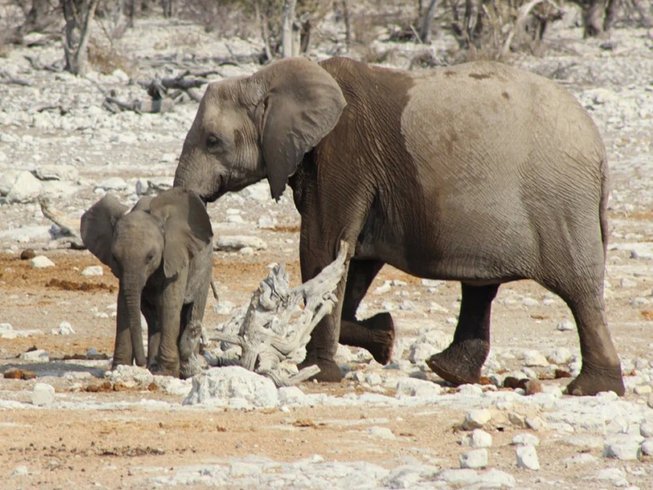
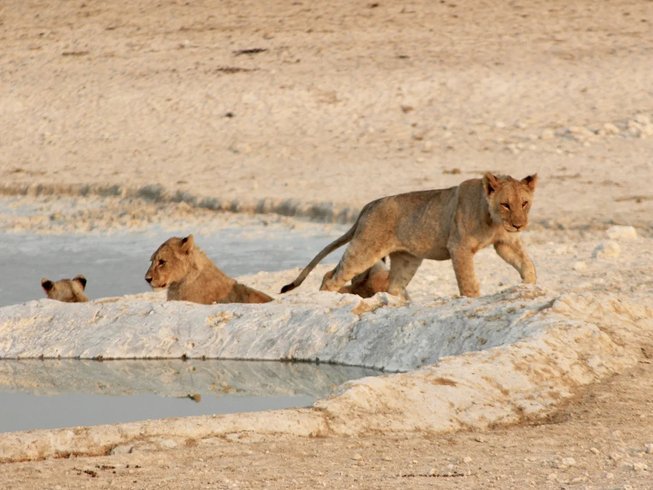
- Spot elephants, black rhino, big cats and 114 mammal species
- Visit the eerie Skeleton Coast and photograph The Zeila, a real shipwreck
- Walk into Sesriem Canyon, carved over two million years by the Tsauchab River
- Sunrise excursion into Sossusvlei and Deadvlei
- Scenic journey through Damaraland
- Scenic return drive over Namibia's central plateau via the Khomas Hochland
- 5 nights accommodation with meals
Skill level
- Beginner
Types
5 activity days in English
Accommodation
Five Nights in Comfortable, En-Suite Accommodation Throughout
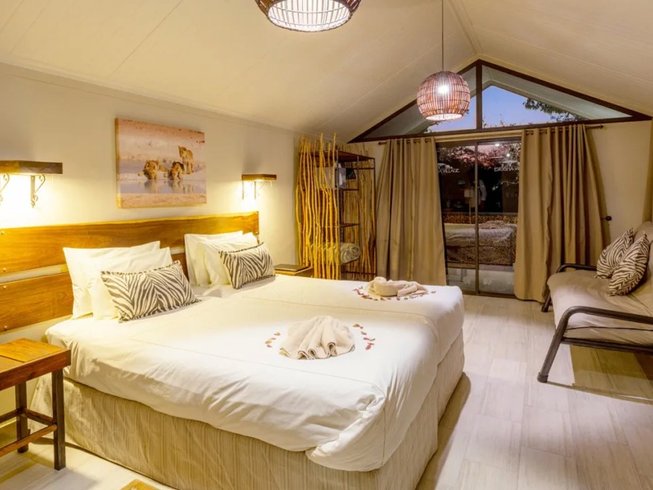
All accommodation on this safari is fully included and features twin-share rooms with private en-suite bathrooms. No camping—every night is spent in a proper bed with hot water, and most properties include a pool, bar and restaurant.
Single travelers will be matched with another guest of the same sex on a twin-share basis by default. A single supplement is available upon explicit request at an additional cost, which grants the guest their own private room for the duration of the tour.
- Night 1 – Inside Etosha National Park: Okaukuejo Resort or Hallai Resort – comfortable lodges within the park perimeter, each with a famous floodlit waterhole just a short walk from your room, renowned for late-night elephant and black rhino sightings
- Night 2 – Near Etosha's Anderson Gate: Etosha Village or Okutala Etosha Lodge – spacious, modern rooms with en-suite facilities in a tranquil bush setting, with buffet dinner included
- Night 3 – Swakopmund: Hotel A La Mer – A centrally located hotel in the heart of town, within easy walking distance of the beach, restaurants and attractions
- Nights 4 and 5 – Near Sesriem, Namib Desert: Desert Camp or Desert Quiver Camp – desert-style accommodation at the gateway to Sossusvlei, with pool, bar and buffet dinner, perfectly positioned for an early-morning dune excursion at sunrise
Program
Namibia's Greatest Hits in Just Six Days
- Full-day open game drive in Etosha National Park – spotting elephants, black rhino, big cats and 114 mammal species across 22,000 sq km of wilderness
- Floodlit waterhole viewing at your Etosha camp after dark, renowned for elephant and critically endangered black rhino sightings
- Scenic journey through Damaraland – majestic mountains, pink granite koppies, and encounters with Himba, Herero and Damara tribal artisans
- Visit the eerie Skeleton Coast and photograph The Zeila, a real shipwreck beached just 15 km south of Henties Bay
- Free time in Swakopmund with optional adrenaline activities – sandboarding and quad biking on the dunes plus world-class restaurants
- Sunrise excursion into Sossusvlei and Deadvlei – climb dunes towering 300 m high and photograph ancient camelthorn trees against a blazing orange sky
- Walk into Sesriem Canyon, carved over two million years by the Tsauchab River, and cool off in its shaded riverbed
- Scenic return drive over Namibia's central plateau via the Khomas Hochland, with a famous apple pie stop at the legendary Solitaire homestead
Day 1: Windhoek – Lodge inside Etosha National Park – 500 km
You will be collected from your accommodation within the Windhoek city limits at 07:00 and transferred to Chameleon Headquarters for a short pre-departure meeting.
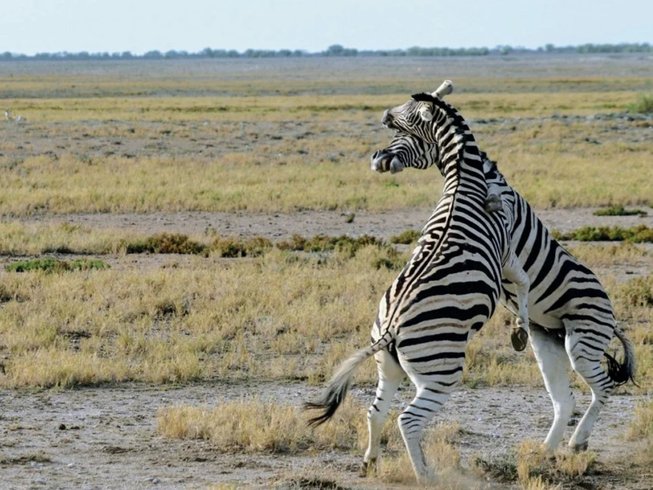
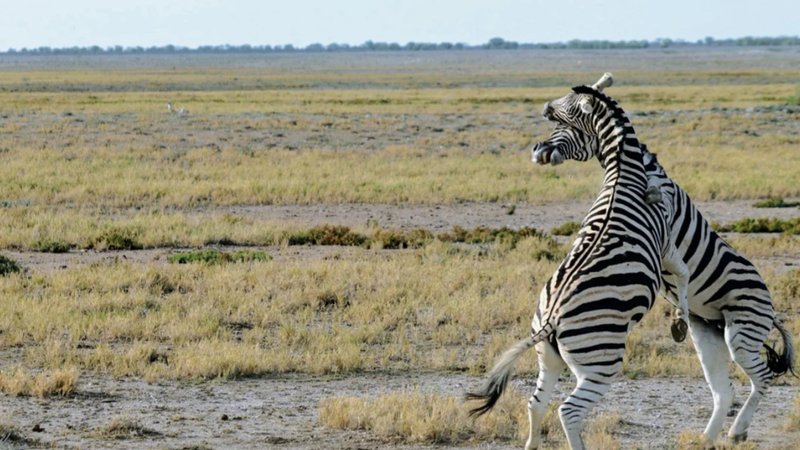
Heading north from Windhoek, you stop briefly at the small town of Otjiwarongo to gather some last-minute supplies before continuing to Etosha, and you enjoy a light lunch pack whilst “on the move”. You enter Etosha National Park and embark on a game drive to your overnight accommodation within the park. Etosha is huge, spanning just over 22,000 square kilometers and home to 114 species of mammal, 350 species of bird, 110 species of reptile, countless numbers of insects, and, somewhat bizarrely, one species of fish. There are good chances of spotting many of these different creatures as you tour through the park, stopping at the various waterholes along the way. All visitors must be in camp by sunset. They aim to arrive at the lodge before sunset, allowing time to settle into your rooms, which feature en-suite bathrooms and tea/coffee facilities. Dinner at the camp restaurant is included in the price.
The ‘game show’ in Etosha doesn’t stop when the sun goes down. All the Etosha camps have floodlit waterholes for extra game viewing opportunities. The waterhole is located within walking distance of your accommodation. A visit, or two, is highly recommended this evening, as you can expect many species to visit during the night. This waterhole is renowned for its popularity with elephants and the critically endangered black rhino.
- Accommodation: Twin share, en-suite bathroom (Okaukuejo or Hallai Resort)
- Meals: Lunch, dinner
Day 2: Etosha National Park – Accommodation near Anderson gate – 70 km
You have the whole day to explore Etosha in an open game viewer, and Chameleon Safaris wants to make the most of it. Early morning is usually a productive time for game viewing, and first thing in the morning is a good time to catch big cats returning from the hunt.
Etosha is a desert landscape, and water is the most scarce natural resource. There are, however, numerous waterholes here, both natural and man-made, and the game driving technique is to take in as many of these as possible. Here, they hope that the game will come to you as thirsty animals come for a much-needed drink.
On the way today, you will stop to have a closer look at the Etosha Pan. The name Etosha translates as ‘great white space’, but this name does not do justice to the immensity of the pan. Over 4,700 square km of dazzling white mineral pan, so big that it can be seen from space.
You exit Etosha at the Anderson gate, close to sunset, and it is just a short drive to your accommodation, which features a comfortable, spacious twin-share room with modern en-suite bathroom facilities. An ideal space to sit back, relax and enjoy the beauty that surrounds you. A buffet dinner tonight at your accommodation.
- Accommodation: Twin share, en-suite bathroom (Etosha Village, Okutala Etosha Lodge)
- Meals: Breakfast, lunch, dinner
Day 3: Etosha – Swakopmund, Accommodation – 510 km
After breakfast, you aim to be on the road by 7:30 this morning. You are heading for the Skeleton Coast, and you are taking the scenic route. You first head south on the main road, passing the small town of Outjo, and then continue west, picking up the gravel road as you travel through the area known as Damaraland.
Damaraland is renowned for its stunning scenery, majestic mountains, vast open grasslands, and tall koppies (small hills) of rounded pink granite boulders, as well as its expansive landscapes and vast open spaces. You also have the opportunity to meet some of the locals, as there are several places along the route today where you can find informal shops selling locally made, handcrafted souvenirs. Represented here are ladies from the Himba, Herero, and Damara tribes, and most often, they are wearing their traditional attire. Here you can interact with some of the colorful local characters who live in this harsh environment. Making a small purchase here is a good way to inject some cash directly into the local economy. You continue through the beautiful landscape, making a stop for a light picnic lunch, under the shadow of Namibia’s highest mountain, the Brandberg. Rising from the desert floor, this giant monolith is 2,573 m above sea level and is formed of pink-tinged granite.
You continue your journey west and soon arrive at the coast, where you encounter the chilly Atlantic Ocean. The whole coastline of Namibia is known as the Skeleton Coast, and it is easy to see why this barren seaboard is so named, with its forbidding mountains and barren beaches. The wind, the waves and the giant fog banks all conspire to push ships onto the beach. The countless mariners who, in olden times, found themselves shipwrecked here faced the stark prospect of no fresh water, no food, no rescue and a slow death by exposure. Their shipmates who went down with their ship were thought to be the lucky ones.
Heading south on the coast road, the next stop is a more recent shipwreck. 15 km south of the small town of Henties Bay, a fishing trawler, The Zeila, was beached in 2008. She was an old vessel that had been sold for scrap and was under tow at the time. The cable snapped, and, like so many ships before her, she was caught in the swell and currents and ended up on the beach. She lies pretty close to the shore and is well-positioned for photos.
You complete the final leg of the journey to Swakopmund, check into your accommodation, and the centrally located hotel is easily explored on foot from a central location. Swakopmund was founded by Captain Kurt von François of the German Empire’s imperial colonial army in 1892. (He also founded Windhoek in 1890.) It is an interesting town to say the least, bounded to the north, the east and the south by the mighty dunes of the Namib Desert and to the west by the Atlantic Ocean. There are still many examples of colonial German architecture to be seen, and the German language remains widely spoken.
Swakopmund boasts some truly excellent restaurants, and again, your guide will be able to provide recommendations and assist with bookings.
- Accommodation: Twin share, en-suite bathroom
- Meals: Breakfast, lunch
Day 4: Swakopmund – Accommodation, near Sesriem – 350 km
You have the option to have a more leisurely start this morning, as you are only leaving Swakopmund in the mid-morning.
Departing Swakopmund at 11:30, you head east into the desert. You first cross the Namib gravel plains, large areas of flat and seemingly barren terrain broken up by huge mountain inselbergs. You have two mountain passes to traverse this afternoon. The first is the mighty Kuiseb Pass, and you follow the road from the top of the hills, dropping steeply down into the canyon carved over aeons by the Kuiseb River on its way to debouch into the ocean at the port town of Walvis Bay. You climb up from the banks of the river and over the pass, traveling through the mountain peaks and on to the second, smaller canyon of the Gaub River, a tributary of the Kuiseb. You emerge from the mountains onto a flat road, and almost immediately you cross the Tropic of Capricorn at 23.5 degrees south. There is a signpost at this auspicious spot, and you stop along the road for photos.
From here, you continue through the desert landscape to the tiny town of Solitaire, where you can stretch your legs and continue to your accommodation. Overnight is in twin rooms with en-suite bathroom facilities. A pool and bar are available, as well as a buffet dinner tonight.
- Accommodation: Twin share, en-suite bathroom (Desert Damp, Desert Quiver Camp)
- Meals: Breakfast, lunch, dinner
Day 5: Sossusvlei – 120 km
Getting into the dune area as early as possible this morning is the aim, and that means a pre-dawn start and a very early breakfast. As you are staying outside of the national park, you will enter the dune area as soon as the gate opens at sunrise.
The best time to photograph the dunes is around sunrise and sunset. This is when you can see towering dunes illuminated a glowing orange, apricot red on one side and swathed in shadow on the other. The depth of field is fantastic at this time of day. From Sesriem, you cover the 60 km into the dunes quickly and arrive at the 2×4 car park where all 2-wheel drive vehicles have to stop. From here, you enter the ancient Tsauchab River-bed for the last 5km leg to Sossusvlei itself.
The Tsauchab River is ephemeral; it only flows seasonally, when there is enough rain, and for the most part, the river-bed is dry. Aeons ago, during these rare floods, the Tsauchab sometimes received enough water to flow all the way to the Atlantic Ocean. However, as the millennia passed and the dune fields began to form (around five million years ago), wind-blown sand invaded the river-beds. The rivers became increasingly constricted by sand until, eventually, the occasional floods could no longer break through the sand barriers that the wind had formed. The valley you drove along this morning to get here is kept free of sand by the Tsauchab, but Sossusvlei is now the permanent end of the water’s reach.
Sossusvlei still occasionally floods (perhaps once every decade). After good rains in the Naukluft Mountains, where the river rises, Sossusvlei can become inundated, and the lake that this creates can last for many months. However, the river can no longer find its original path to the Atlantic. There is a 4×4 shuttle service that will transport you through the sandy terrain of the riverbed.
You will visit Dead Vlei, an ancient pan surrounded by dunes, which is strikingly populated with dead, skeletal camelthorn trees. These trees have been a feature of this landscape for over 1000 years. Dunes almost surround Sossusvlei; just one narrow path, kept open by the Tsauchab River, remains. You have time to explore the area on foot and to climb one of the highest dunes in the world, some towering 300 m above you; the views are breathtaking and justly famous.
You drive back the way you came (there is only one road), stopping at the iconic Dune 45 (so named as it is 45 km from Sesriem). There is time to climb Dune 45 if you still have energy, or a sit in the shade at the base of the dune will suffice.
Driving back to Sesriem, you take a short excursion to see the Sesriem Canyon. Only four km from Sesriem, this canyon has been carved out of the landscape by the Tsauchab River. Approximately two million years ago, a period of intense cold known as an ice age occurred in Europe. This caused glaciers to form and led to a global decline in sea level. The knock-on effect of this at Sesriem Canyon was that it increased the length and water flow of the Tsauchab River. This greater force of water allowed the Tsauchab to begin cutting through the terrain, resulting in the canyon you can see today. You can easily walk into the river-bed, it is usually much cooler in the canyon, and you can follow the river for some way along its journey to Sossusvlei.
You head back to your accommodation in the late afternoon.
- Accommodation: Twin share, en-suite bathroom (Desert Camp, Desert Quiver Camp)
- Meals: Breakfast, lunch, dinner
Day 6: Namib Desert – Windhoek – 320 km
Today is your last day, but excitement is still on the menu. You head back to Solitaire, where your guide will get you a sample of the apple pie that has made this homestead famous.
There is some lovely mountain scenery on the drive back to Windhoek. The road climbs up onto and over Namibia’s central plateau, and you return to Windhoek via the small community at BűellsPort and the small town of Rehoboth. You arrive mid-afternoon and will be dropped off at Chameleon Backpackers or the accommodation of your choice within Windhoek city limits.
- Accommodation: None
- Meals: Breakfast
Location
A Journey Across Namibia's Most Spectacular Landscapes
This safari departs from Windhoek, Namibia's relaxed and safe capital city, and loops through four of the country's most celebrated regions before returning. Each destination along the route offers something entirely different—from vast game-rich savannah to ancient desert, dramatic coastline to canyon.
- Etosha National Park – One of Africa's greatest wildlife sanctuaries, spanning 22,000 sq km in northern Namibia, home to elephant, lion, leopard, cheetah, black rhino and hundreds of bird species
- Damaraland – A remote and strikingly beautiful wilderness of pink granite mountains, open grasslands and traditional communities of the Himba, Herero and Damara peoples
- The Skeleton Coast – Namibia's wild and forbidding Atlantic coastline, littered with shipwrecks and shaped by cold ocean currents, towering fog banks and relentless surf
- Swakopmund – A charming colonial-era coastal town with German architecture, excellent restaurants, and a base for adventure activities including sandboarding and quad biking
- Sesriem and Sossusvlei – Gateway to the Namib Desert, the world's oldest desert, and home to some of the highest dunes on Earth, the ghostly Deadvlei pan and the Sesriem Canyon

Food
Guests should advise their dietary requirements ahead of time.
Meals are provided as indicated in the itinerary throughout the tour, except on Day 3 in Swakopmund, where dinner is at the client’s own expense. Guests can choose from a variety of local restaurants; The Tug Restaurant is a popular option among guests.
All drinks are excluded, except for tea, coffee, and tap water. Bottled water is not included.
The following meals are included:
- Breakfast
- Lunch
- Dinner
- Drinks
The following drinks are included:
- Water
- Coffee
- Tea
The following dietary requirement(s) are served and/or catered for:
- Vegetarian
- Vegan
- Gluten Free
- Regular (typically includes meat and fish)
- Pescatarian
- Lactose Free
- Other dietary requirements on request
Things to do (optional)
If you choose not to have a lie-in in Swakopmund, then Swakopmund offers many opportunities to keep you busy during your morning here. The town center is small and easily explored on foot, but there are also many extra, optional activities available. For those with a love of adrenaline, quad biking and sandboarding are very popular if you fancy careening down the slip face of a dune at 60 km per hour. Your guide will discuss all the options with you in advance and will be able to facilitate any bookings that you would like to make.
What's included
- 1/2 day game drive in the Chameleon Safaris Vehicle
- Full day game drive in an open vehicle
- Sossusvlei excursion (including 4×4 shuttle)
- Transport in a custom-built safari vehicle with USB charging capabilities and air-conditioning
- Services of a professional English-speaking guide
- National park entry fees (2 days Etosha and 1 day Sossusvlei)
- Pick up and drop off within Windhoek city limits
- Inbound and outbound shared shuttle to Hosea Kutako International Airport (WDH)
- 5 nights’ accommodation in twin share rooms with en-suite bathrooms
- Meals as itinerary
- Tap water
What's not included
- Optional activities
How to get there
Recommended Airports
Transfer included
Hosea Kutako International Airport
401 km away from your destination
Arrival by airplane
Please book your flight to arrive at Hosea Kutako International Airport (WDH). Transfers are included in the price. Participants can also be picked up at their accommodation establishment, hotel, or guest house on the morning of the departure.
Cancellation Policy
- A reservation requires a deposit of 14% of the total price.
- The deposit is non-refundable, if the booking is cancelled.
- The rest of the payment should be paid 30 days before arrival.

Reviews
No reviews yet
For this organizer you can guarantee your booking through BookAllSafaris.com. All major credit cards supported.