5 Day Sunset Safari Tour in Eastern Moremi Game Reserve and Chobe National Park in Botswana
Botswana Sunset Camping Safari
This six-night, seven-day "Sunset Safari" offered by Okavango Exploration Safaris provides a deep immersion into Botswana's premier wilderness areas. The program combines the tranquil waterways of Khwai Concession, the predator-rich plains of Savuti, and the elephant-filled riverfront of Chobe National Park.
Key information
- Private or group safari
- Minimum of one and maximum of eight participants
- Starts in Maun and ends in Kasane
- Languages spoken: English
- All Botswana park fees included for activities in the itinerary
Highlights
- 2 nights each in Moremi / Khwai, Savuti in Chobe National Park, and Chobe Floodplain in Chobe National Park
- Mokoro excursion
- River cruise on the Chobe River
- Services of a professional guide, a camp chef, and an assistant
- Transport in specialized safari vehicles
- Window seat for everyone
- 6 nights accommodation in tents with camping equipment
- All meals included as per indicated, plus tea / coffees, soft drinks, local alcohols, mineral water
Types
6 activity days in English
Accommodation
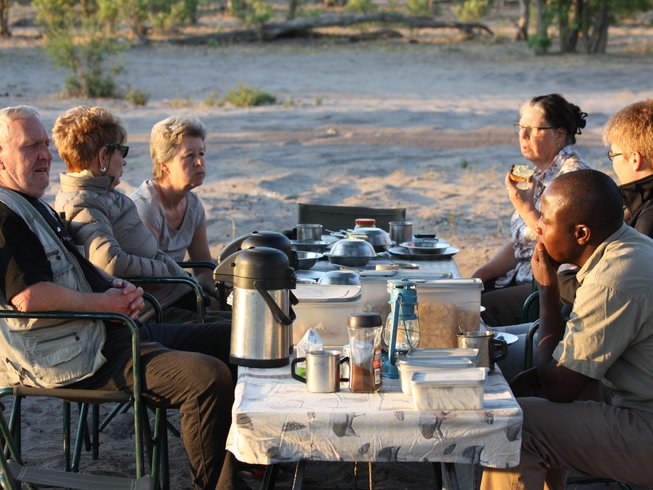
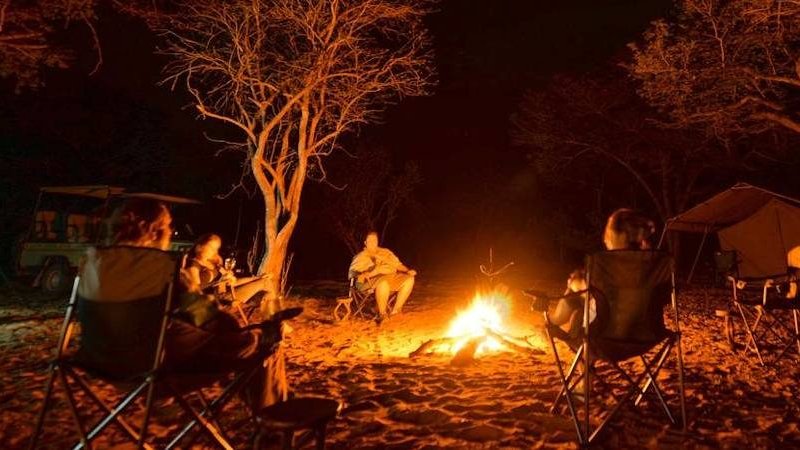
This will be a camping safari wherein all camp chores are carried out by Okavango Exploration Safaris' teams. There will be one guide with the guests at all times and a backup team (chef and camp assistants) in a backup vehicle, setting up and breaking camps, cooking meals, etc.
Very spacious tents (3m x 3m x 1.95m) with bedrolls and bedding are included, as well as ensuite private bush ablutions (shower, toilet, toiletry stand) with direct access from the tent.
Program
This safari is perfect for those wishing to visit the best wilderness areas in Botswana in a very comfortable mobile camping safari style. The fully serviced safari is a non-participation safari, wherein the Okavango Exploration Safaris team will carry out all the necessary camp chores to keep the safari running smoothly. The tents are large (3m x 3m) canvas dome tents with camp beds and bedding provided. Each tent has an ensuite bush toilet and shower.
Day 0
Guests must arrive a day before the safari starts to embark on the safari and head to the park the following morning at Khwai concession. This pre-safari overnight will be arranged separately by guests.
Day 1:
- Pick up guests from Maun and transfer to Khwai Concession
- Arrive at camp for a briefing and late afternoon game drive along the Khwai River
Day 2: Khwai Concession and Mokoro experience
- Morning: Traditional mokoro excursion through the Okavango Delta's shallow channels, guided by local polers
- Afternoon: Game drive in search of leopards and wild dogs, followed by a night drive to spot nocturnal species
Day 3: Transfer to Savuti
- Early morning departure for a four to five-hour drive to the Savuti region of Chobe National Park
- Game drive en route through the Mababe Depression, arriving at camp in time for a late afternoon safari
Day 4: Exploring Savuti Marsh
- Full day dedicated to tracking Savuti's famous predator prides and elephant herds
Day 5: Savuti to Chobe Riverfront
- Morning game drive in Savuti before transferring to Chobe Riverfront near Kasane
- Check in at your riverside camp and enjoy an evening game drive along the floodplains
Day 6: Chobe Wildlife and scheduled boat cruise
- Morning: Game drive in Chobe National Park, known for the highest concentration of elephants in Africa
- 13:00: Specialized boat cruise on the Chobe River - This early afternoon start will provide unique opportunities to see elephants swimming and hippos active in the water
Day 7:
- Final safari breakfast at the camp
- Transfer to Kasane International Airport for onward flights
Location
Moremi Game Reserve encompasses the eastern extremities of the Moanachira channel and almost the entire Khwai River, which dies in the Kalahari sands a few kilometers from the border of Moremi. This intrusion of water into the otherwise barren Kalahari Sands results in an ecological richness and diversity rarely found in nature.
The Chobe River forms the northern boundary, and in the extreme southwest corner, it borders Moremi Game Reserve.
The primary function of Chobe National Park is the protection of the full range of southern Africa’s large predators, as well as the localized puku antelope and migratory elephant population, which can number up to 70,000.
The Chobe National Park offers extreme contrasts and a variety of wildlife experiences within the confines of one park. It covers a variety of vegetation types and geological features that vary from the almost tropical habitat of the Linyanthi swamp to the severe, desert-like landscape of the Savuti, and from the lush Chobe floodplain grassland to the deep sands of the Brachestegia woodland.
Four main areas have been developed in Chobe (namely: Savuti, Chobe River, Linyanthi, and Nogatsaa), each of which offers a unique experience. The Savuti and Chobe River Front areas will be discussed since these will be the two areas of focus during the trail.
Chobe River Front
The Chobe National Park was named after the Chobe River, which forms the northern boundary of the park. The Chobe River area is very rich in plant life, offering Bachestegia sand veld, mopane woodland, mixed Combretum veld, floodplain grassland, and the riverine woodland. The latter has, unfortunately, been severely damaged by elephants and has in places been reduced to scrub or totally denuded.
Perhaps the greatest attraction of the Chobe River area is the elephants, which can almost always be seen there. Their late afternoon visits to the water’s edge offer hours of fascinating viewing and wonderful opportunities for photographers.
Along with the huge herds of elephants, huge herds of buffalo can also be seen in this area during the dry season. You can also expect to see tsessebe, waterbuck, roan, eland, sable, giraffe and, if you are lucky, one of the rare puku.
The floodplains of the river make an ideal viewing area, with mixed patches of open grassland, thickets of bush, and riverine forest. In the river itself, you should see hippo and crocodile. The Chobe River area has a rich selection of bird life as well. Exquisite sunsets make this a wildlife experience not to be missed.
Chobe River
The Chobe River has its origins in the highlands of Angola and flows in a south-easterly direction. This section of the river is called the Kwando.
When it enters Botswana, it not only changes its name, but also undergoes a dramatic 90-degree change in course at the point where it meets a major fault line. The name of the river changes another three times before it reaches the Zambezi River.
After entering Botswana, the Kwando River becomes the Linyanthi. At Parakurungu, it becomes the Itenge, and only near Ngoma Gate does it become the Chobe River. From the point where the Chobe abruptly bends, the Magwegqana or Selinda spillway links the Delta to the Chobe. It is popularly believed that the Selinda can flow in both directions, resulting in the Chobe doing the same.
This is not true. In fact, the water merely backs up for a considerable distance, creating the impression of a change in the current.
This wildlife reserve was declared by the BaTawana people in 1963, the first wildlife sanctuary to be created by an African tribe in their own area, and as such is unique. This act was described at the time as a shining mark in African tribal history.
In the late 1800s, a Rinderpest epidemic spread through the continent, wiping out a large percentage of the wildlife and cattle in Africa. As wild animals are the hosts of the Tsetse fly, this led to a natural decrease in its population in the area. Now, it is possible for the movement of cattle into and through the area without the fear of disease.
The BaTawana tribe feared that continued competition between the returning game and the cattle herds for grazing, and that uncontrolled hunting would lead to the destruction of the habitat and a decrease in the game populations.
During this time (late 1950’s, early 1960’s), the tribe was being governed by Mrs. Moremi, the widow of Chief Moremi III, whose son, Matiba, was too young to rule. Thus, the Moremi Game Reserve was officially proclaimed on 15 March 1963. It is administered today by the Department of Wildlife and National Parks; it is a rich and fascinating area.
The Moremi Game Reserve forms an intricate part of the Okavango Delta, comprising permanently swamped areas, seasonally swamped areas, and dryland.
Located on the northeast side of the delta, it is probably the prime tourist destination in Botswana, due to the fact that it encompasses several different types of ecological zones. The total surface area of this reserve is 4,871 square kilometers. This is almost one-third of the Okavango Delta, a fact that Botswana can be very proud of.
The dryland areas of Moremi consist mainly of mopane veld (Colophospermum mopane). The giant mopane trees form the canopy woodland and lend an atmosphere unique to this area. The other main vegetation types are riverine woodland, floodplain grassland, marginal woodland on the edges of the floodplains, Terminalia sericea sand veld, Acacia erioloba sand veld, and Hyphaene petersiana island communities.
Teeming with birdlife and wildlife, Moremi is a prime wildlife area where elephant, hippo, buffalo, lion, and most other game (including eland, kudu, roan antelope, and, if you’re lucky, even leopard) can be seen in abundance. Birdlife (both in the delta and dry land sections) is also excellent, especially along the Khwai River.
During the dry season, a congregation of all species (birdlife and wildlife) along permanent rivers and waterholes makes Moremi Game Reserve one of the most unforgettable wildlife experiences in Africa!
Within the Chobe National Park, Savuti is perhaps one of the best-known game-viewing areas in the country. Under ideal conditions, the number and variety of animals seen can be quite staggering.
The Savuti area supports mainly camelthorn (Acacia erioloba) sandveld, silver terminalia (Terminalia sericea) sandveld, scrub savanna, and mopane veld. Savuti’s almost desert-like landscape with a scorching sun, loose, hot sand, animals escaping the heat by clumping together in the limited available shade, and elephants impatiently lining up to get to the ever-dwindling water supply all offer a wildlife experience so different, yet so true to Africa.
It is almost impossible to imagine that this desolate, harsh landscape was once submerged beneath an enormous inland sea. Geologically, the five main features of Savuti (namely the Magwikhwe Sand Ridge, the Mababe Depression, the Savuti Marsh with its dead trees, the Rocky Outcrops, and the Savuti Channel) are all intricately linked in a fascinating manner.
There is still some speculation as to how this once massive lake received its waters. The most popular explanation is that once, the Upper Zambezi, the Chobe, and the Okavango rivers flowed together across the north of Botswana and down to the sea via the Limpopo.
A gentle warping of the Earth’s crust dammed this flow to create a vast lake. In time, however, further crustal movement caused these rivers to find a new route to the sea. The direction of these rivers changed by faulting; the Upper Zambezi and the Chobe turned to the northeast and, after plunging over the Victoria Falls, joined what is now the Middle Zambezi.
Trapped by an emerging rift valley, the Okavango bled its waters into the vast accumulations of sand to create the delta that people see today. Condemned by a changing climate which reduced rainfall and brought a return of almost desert-like conditions, the super-lake, cut off from its supplies of water, dried up and was no more.
Savuti Channel
One of the great mysteries and fascinations of Savuti is its famous channel. It runs a distance of 100 kilometers from the Chobe River, through a gap in the sand ridge, to the Mababe Depression. Falling only approximately 18 meters (about 18 centimeters for each kilometer of distance covered), this channel brings water from the Chobe to Mababe, creating a small marsh where it enters the depression.
It is the channel and its water that explain the fantastic abundance of game that can sometimes be seen at Savuti. However, the channel does not always flow, and therein lies its great mystery.
Reports from early explorers confirm that the channel was flowing in the 1850s and until about 1880. At that time, it ceased to flow and remained dry until about the mid-1950s, when, without explanation, it began to flow again. Since then, it has “switched” on and off several times. At the moment it is dry. It is this quixotic flow that explains the dead trees that you will see in the channel.
The long dry period of this century gave the camelthorn trees (Acacia erioloba) enough time to establish themselves and grow to full size. The flood that followed drowned the trees both in the channel and on the edge of the marsh. The dead trees, which have remained erect for more than 35 years, are today one of the most prominent features of the Savuti landscape.
A possible explanation for the erratic flow of the Savuti channel can be the tectonic movements (earth crust movements). Even without water from the Chobe, Savuti remains a place of enchantment, of singular beauty, and boasts one of the greatest concentrations of animals in Southern Africa.

Food
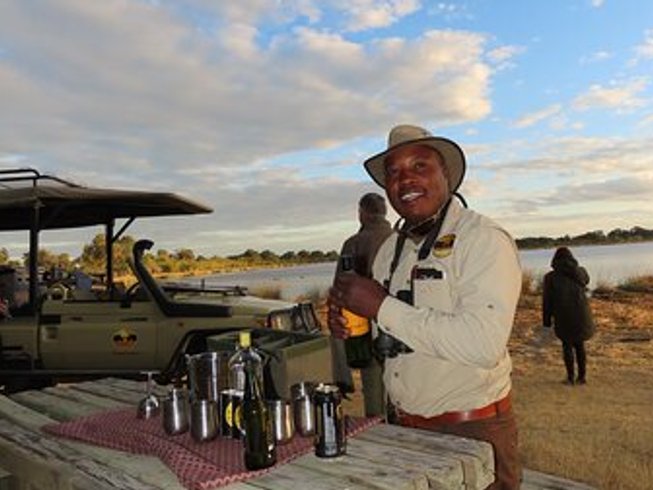
All meals that are indicated (B - breakfast, L - lunch, D - dinner), teas / coffees, soft drinks, local alcoholic drinks, and still / mineral water are included in the price.
The following meals are included:
- Breakfast
- Lunch
- Dinner
- Drinks
The following drinks are included:
- Water
- Coffee
- Tea
- Soda
- Alcoholic beverages
The following dietary requirement(s) are served and/or catered for:
- Regular (typically includes meat and fish)
What's included
- All transfers and activities as per the itinerary
- Services of a professional guide, a camp chef, and an assistant
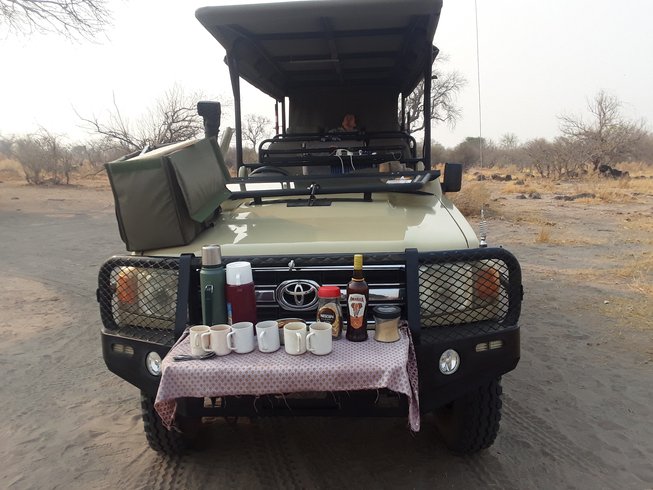
- Transport in specialized safari vehicles - 4×4 safari vehicles custom-built by Okavango exploration; safari - custom-built trailers - one backup vehicle specifically dedicated to setting up / packing up the camp
- All Botswana park fees for activities included in the itinerary
- 6 nights accommodation
- Camping equipment (spacious bow tents with camp bed and full bedding with ensuite bush ablutions)
- All meals that are indicated (B - breakfast, L - lunch, D - dinner)
- Teas / coffees, soft drinks, local alcohols, mineral water
What's not included
- Airfare
- Airport transfers
- Visas
- Tips
- Curios
- Optional excursions (activities in Livingstone / Victoria Falls)
- Insurance to cover cancellation and curtailment, medical, baggage, and emergency evacuation
- Any increase in National Park fees
How to get there
Recommended Airports
Transfer included
Maun Airport
2 km away from your destination
Cancellation Policy
- A reservation requires a deposit of 14% of the total price.
- The deposit is non-refundable, if the booking is cancelled.
- The rest of the payment should be paid 30 days before arrival.

Reviews
No reviews yet
For this organizer you can guarantee your booking through BookAllSafaris.com. All major credit cards supported.